A thief can move an unsecured motorbike in seconds, particularly where it is left in a quiet driveway, shared car park or outside work all day. The right motorbike security devices make that job slower, louder and far less appealing. They can also help protect the time and money you have put into building a no-claims discount.
Security is not about buying the most expensive gadget and hoping for the best. It is about using layers that suit where you park, how long you leave the bike, and what would make a thief choose another target instead.
Why motorbike security matters to your insurance
Motorbike theft can lead to a claim, an excess to pay and, depending on your policy, a reduction in your no-claims discount at renewal. Replacing a stolen bike is only part of the disruption. There may be time off the road, the cost of protective gear left with the bike, and the hassle of finding replacement transport.
Many insurers ask where your motorbike is kept overnight and what security is used. A locked garage, approved lock or tracker may affect the terms or price available, but there is no universal discount. Insurers assess risk in different ways, so always answer the quote questions accurately rather than assuming a device will automatically reduce your premium.
If your policy requires a particular security device, use it whenever the bike is left as specified in the policy. Failing to do so could affect how a theft claim is handled. Keep receipts, product details and photos of fitted equipment too.
Motorbike security devices worth considering
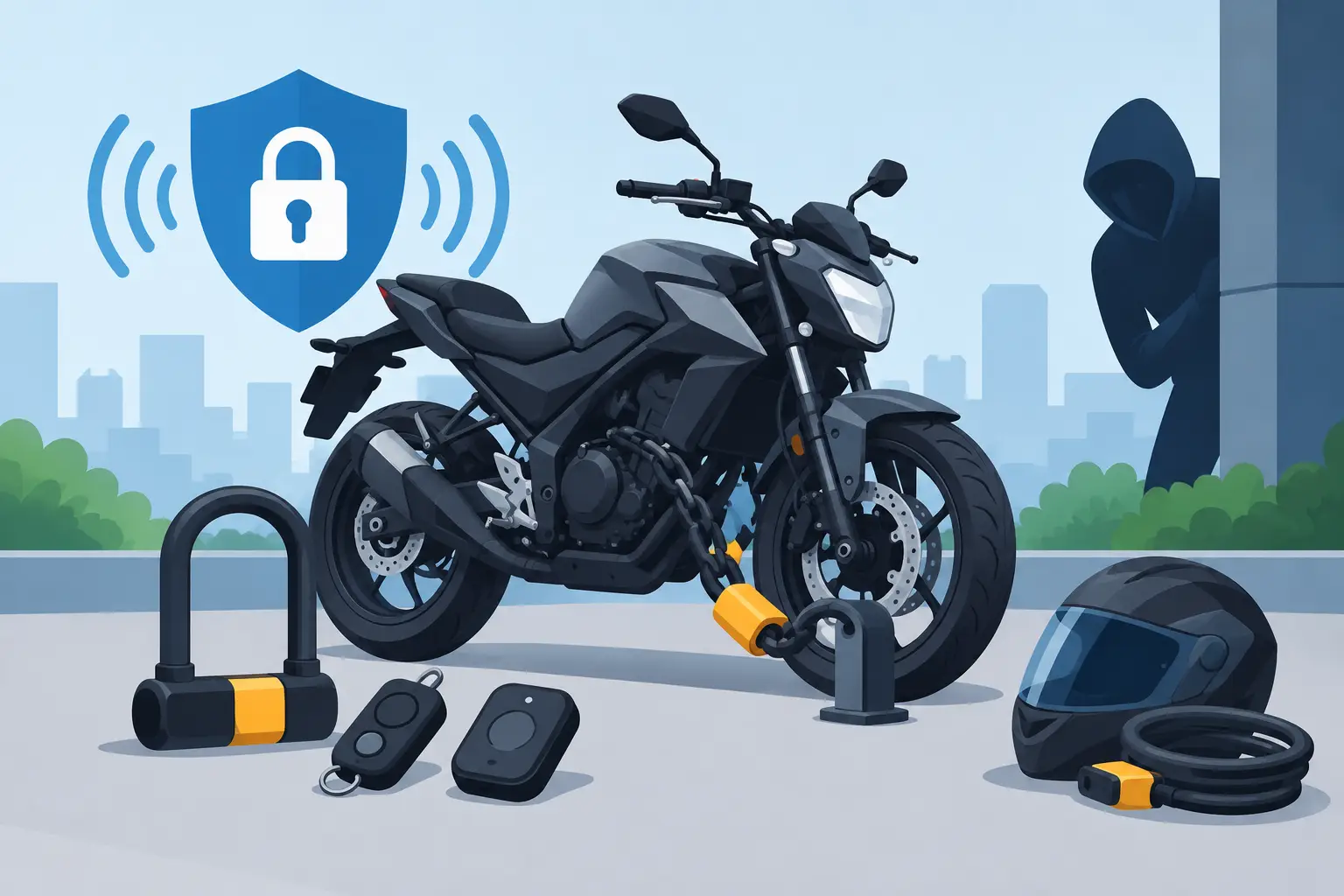
The strongest set-up combines a visible physical barrier with an alarm, tracker or secure parking arrangement. A determined thief may overcome one device, but each additional layer adds time, noise and risk.
Disc locks: compact protection for short stops
A disc lock prevents the wheel from turning and is easy to carry under the seat or in a bag. It is a practical choice for café stops, commuting and quick errands, especially when it has a brightly coloured reminder cable to reduce the chance of riding away with it fitted.
Its limitation is equally clear: a disc lock does not attach the bike to anything. Two people may still be able to lift a lightweight machine into a van. Treat it as a useful first layer, not your only defence where theft is a concern.
Chain and padlock: make removal difficult
A heavy-duty chain used through the frame or rear wheel, then secured to an immovable object, is one of the most effective visible deterrents. At home, a ground anchor fixed into solid concrete can turn a good chain into a much tougher obstacle.
Look for independent testing rather than relying on a bold label on the packet. Products rated to recognised standards, such as Sold Secure Motorcycle Gold or Diamond, are designed to withstand more serious attacks than lightweight chains. Choose a chain that is thick enough to resist tools but still realistic for you to carry and use. A lock left at home because it is too awkward delivers no protection on the road.
Avoid looping a chain only through a wheel that can be removed. Securing the chain through the frame, swingarm or another substantial fixed point is generally harder to defeat. Keep it off the ground where possible, as this gives thieves less support for striking or cutting it.
Alarms and immobilisers: add noise and delay
An alarm can draw attention when a bike is moved, tilted or tampered with. An immobiliser makes it harder to start without the correct fob or key. These features are especially useful where the bike is parked close enough for someone to hear an alert, such as outside your home or workplace.
There is a trade-off. A false alarm can irritate neighbours, and a battery-powered system needs checking. Factory-fitted systems are convenient, while aftermarket fitting should be carried out properly and declared to your insurer if it changes the bike from its standard specification. Ask whether the system has an approval level your insurer recognises before paying for installation.
Trackers: a recovery tool, not a replacement for locks
A tracker can help locate a stolen motorbike after theft, and some units use a monitored service that contacts you or a recovery partner if the bike moves unexpectedly. This can be particularly valuable for higher-value bikes or models targeted by organised thieves.
Trackers usually involve installation and an ongoing subscription. Signal can also be limited if a bike is stored underground, shielded or moved quickly. Do not rely on a tracker instead of locking the bike down: its role is to improve the chance of recovery, while physical security aims to prevent the theft happening in the first place.
Secure the place where your bike sleeps
Overnight parking often has the biggest influence on your risk. A locked garage is preferable to leaving a bike on the street, but a garage door alone is not enough if it can be forced open. Use an anchor inside, secure the bike with a chain and avoid leaving keys, documents or riding gear in the same space.
A cover is a low-cost extra layer. It conceals the make and condition of the bike, makes casual tampering less convenient and may discourage opportunistic theft. Choose a cover that can be secured underneath, but never fit it over a hot exhaust.
For flats, communal parking and driveways, identify the strongest fixed object available before buying a chain. Railings may be unsuitable or prohibited, while street furniture is not always secure. If there is no reliable anchor, combine a disc lock, alarm and cover, then park in a well-lit place with regular footfall and, where available, CCTV.
Everyday habits that improve motorbike security
Good habits cost nothing and often matter as much as the hardware. Lock the bike even when stepping away for a few minutes. Turn the steering lock on, remove the key and do not leave a spare key hidden nearby. If you have a keyless model, store the fob in a signal-blocking pouch at home to reduce the risk of relay theft.
Be careful with online posts too. A detailed photo showing your registration, location and daily routine can give thieves useful information. When selling a bike, meet buyers safely and do not hand over keys or documents before you are satisfied with the arrangement.
If you notice damaged locks, attempted theft or suspicious activity around where you park, act quickly. Move the bike if possible, improve the security set-up and report crime or concerns through the appropriate channels. Replacing a compromised lock is cheaper than discovering it was weakened during a later attempt.
Choosing motorbike security devices for your situation
Start with the risk rather than the product. A low-value commuter parked on a busy high street for short periods may benefit most from a portable disc lock and alarm. A premium bike kept overnight on a driveway needs a stronger plan: a heavy chain, fixed anchor, cover and possibly a tracker. If your bike lives in a locked garage, secure it inside the garage as well.
Check the device weight, fitting requirements and replacement costs. Consider how it performs in rain and winter grime, whether you can operate it while wearing gloves, and whether you will genuinely use it every day. The best security arrangement is the one you can repeat without cutting corners.
Before buying, check your insurance documents or speak to the insurer about any security conditions. Do not describe a device as approved unless it meets the exact standard requested. When comparing motorbike insurance, accurate information about storage, mileage and security helps produce quotes that are relevant to the cover you need.
A visible lock, sensible parking and a routine you follow every time can make your bike a much less attractive proposition. Protect the machine first, then compare cover carefully – who compares wins.